
Oil On Canvas - 100cm X 90cm
Hunting the Earl of Rone is a custom that takes place in the village of Combe Martin, Devon during the May Spring Bank Holiday weekend. The procession was originally banned in 1837 due to licentiousness and drunken behaviour but was revived in 1974. According to local legend the Earl of Rone was a man named Hugh O’Neill, that was forced to flee his Native Ireland to avoid capture and execution by the British that had marked him as a wanted man for his part in the Irish rebellion. Whilst attempting to reach the shores of France he got caught in a storm and was shipwrecked and landed on a local bay known as Raparee Cove, where he hid in the woods surviving only on the ships sea biscuits where he was eventually discovered by a mob of angry locals. The legend is now commemorated and recreated every year with his imagined capture and execution.

Oil on canvas - 30cm x 25cm
Every year on the first or second Sunday of February the annual Clown’s church service takes place at the All Saints church in Haggerston, London, where clowns gather from all over the British Isles and even abroad to remember the life of the pioneer of modern clowning, Joey Grimaldi (1778 - 1837). The service originally took place in 1946 at Grimaldi’s graveside at the old St James Church, Pentonville Road, Islington, and then moved to the Holy Trinity Church in Dalston, also known as ‘The Clowns Church’ that up until last year housed a museum and archive including the Clowns Egg Register, a custom that clowns use to trademark their individual clown face designs by painting the patterns on to eggs. Over the years the service has grown in popularity and had to be moved to its current venue to accommodate the growing numbers of clowns, worshipers and members of the general public that wish to pay their respects to Grimaldi.

Oil on Canvas - 30cm x 25cm
Every year on the last Sunday of September, starting at Guildhall square and then ending up at the St Mary Le Bow church the London tradition of the Pearly Kings and Queens Harvest Festival takes place. The custom itself of the Pearly Kings and Queens was founded in the 19th century by Henry Croft who was an orphan, road sweeper and rat catcher from Somers Town, London, who after noticing the costermongers (a person who sells goods, especially fruit and vegetables, from a handcart in the street') practice of wearing buttons sewed on to their clothes as a way of recognising and helping one another was inspired to begin covering his own clothes with pearl buttons to attract attention to himself whilst out raising money for local orphanages and other charities. As his popularity and demand grew he soon appointed various Pearly Kings, Queens, Princes and Princesses from each London borough and in 1911 an official organised Pearly society was formed. The tradition is still thriving today and much like the actual
royal family the honours and titles are inherited and passed down and kept within the original Pearly families.

Oil on canvas - 50cm X 40cm
The Hallaton Hare Pie Scramble and Bottle Kicking tradition takes place annually on Easter Monday in the village of Hallaton, Leicestershire. The custom begins with a procession that ends up at the local church where the Hare pie scramble begins. The local folklore on the origins of the Hare pie is to do with the lucky escape of a well to do lady, who once upon a time lived upon the hill now known as 'Hare Pie Bank' on which whilst out walking was charged at by a ferocious bull, when seemingly out of nowhere a Hare ran from the bushes and into its path saving her from death or serious injury.
To celebrate her escape she gave a yearly sum of money to the local parish to make two large Pies and to supply two kegs of beer (known locally as bottles) to be shared out to the poor of the village. This evolved in to somewhat of a scramble as people fought with the men of the neighbouring village of Medbourne that soon crashed the event in an attempt to steal the 'bottles' of beer for themselves. The Hallaton men would then respond by fighting back and retrieving the stolen goods and the game now known as 'Bottle Kicking' evolved from there. The same game that locals believe inspired William Webb Ellis, the inventor of Rugby to pick up a football and run with it after witnessing the game first hand whilst visiting his aunt that lived in the town.
Other local beliefs is that the pie is a continuation of a Pagan tradition in which Hares were sacrificed to the spring goddess ‘Eostre’ who’s name later evolved into the word ‘Easter’ the Christian replacement for the old Pagan celebration.

Oil on Canvas - - 80cm x 70cm
The tradition of the Straw Bear, that is also found in parts of Germany, Austria, the Czech Republic and Poland, is believed to have originated from the medieval carnival figure of the Wild Man or as a ritualistic expulsion of winter connected to fertility rites and bountiful harvest traditions. The Straw Bear of Whittlesea I was told by locals was originally started by farmers on the Tuesday following Plough Monday, that would go from door to door to entertain spectators in return for beer, tobacco and beef to help them through the tough months of winter. If they failed to oblige their front lawns would fall victim to the ploughs of the plough boys that accompanied the straw bears. It is also speculated to have origins going back to the real dancing bears that used to be paraded through the streets and taverns in medieval times much like the Straw Bear is today. This year was a special year with it being 40 years since the Straw Bear custom was revived in Whittlesey. Prior to its revival the tradition was stopped in 1908 due to drunk and disorderly behaviour.
Oil on Canvas - 65cm X 80cm
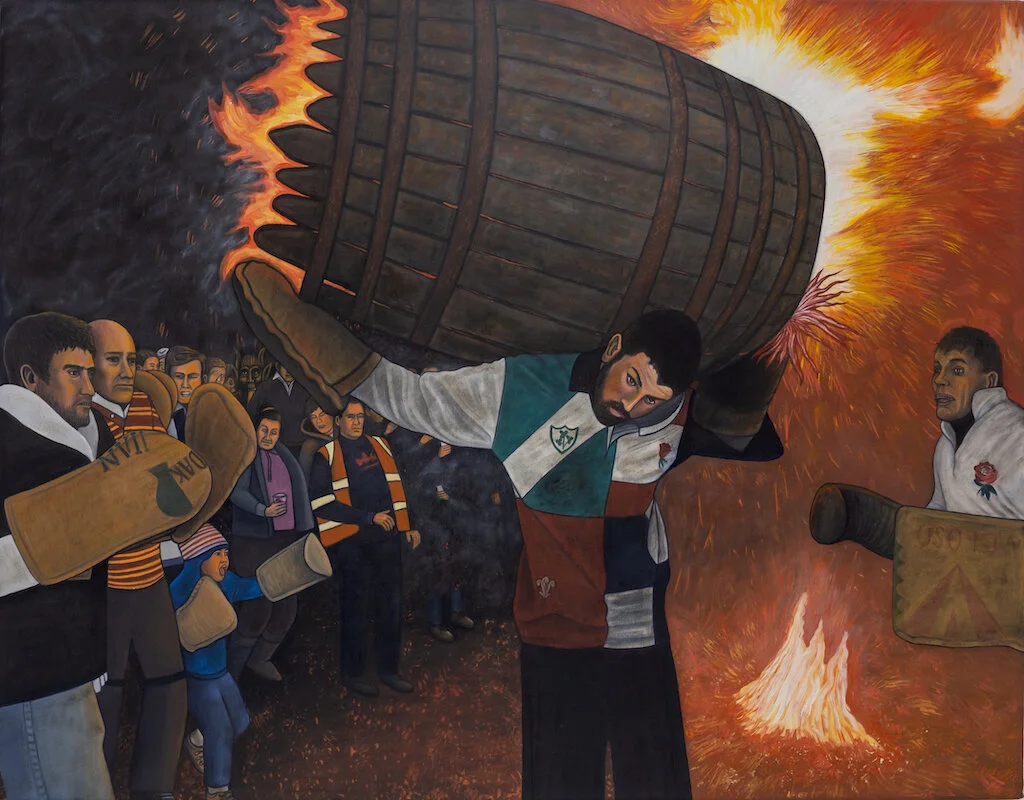
The Flaming Tar Barrels of Ottery St Mary in Devon is an annual festival that takes place on the 5th of November and is believed by the locals to go all the way back to the precursor of Halloween, the ancient fire festival of Samhain where the veil between the living and the dead was at its thinnest and spirits could wander back from the after life and bonfires were lit as a way of deterring evil spirits. In Ottery residents run with the flaming tar barrels hoisted on their backs beginning with the children’s Barrel’s that starts mid afternoon, and ending with the honoury Midnight Barrel that is the largest and most dangerous of all! To participate you must have been born in the town and despite the obvious dangers it is considered a great honour to take part in the ancient tradition that has been kept alive and passed down by their ancestors for centuries. The event is not only dangerous for those taking part, but equally for the spectators alike, as the unpredictable ever changing direction of the Barrels causes panic in the densely packed streets, as the mass body of the crowd sways, splits and falls off, crushing itself up against the buildings of the town square where the majority gather.

Oil On Canvas - 30cm X 25cm
The tradition of the Brittania Coconut dancers that takes place annually on Easter Saturday is said to have derived from Moorish pirates that first settled in Cornwall and found work in the Tin mines. During the 18th century when the Cornish mining industry began to decline some men left and moved to Lancashire to work in the coalmines, bringing the dance with them. The dance itself I was told by one of the ‘nutters’ is a spring ritual of Pagan or medieval origin to celebrate the coming of spring, the renewal of vegetation and to move on the evil spirits of winter’.

Oil on Canvas - 30cm x 25cm
The Haxey Hood is an ancient game that takes place on the 6th of January, the traditional Twelfth day of Christmas. The custom is believed to have originated in the 14th century, when a landowner named Lady de Mowbry was out riding when a sudden gust of wind blew off her fine silk hood. Thirteen farm workers rushed to retrieve the hood that was now being blown left right and centre across Lady de Mowbry's land. After an animated chase one of the farm labourer’s finally managed to catch it. Plagued by shyness instead of handing the hood back to the lady himself, he got another of the workers to do it for him. Lady de Mowbry thanked the man who did return it and said that he had ‘acted like a Lord, whereas the worker who actually caught it was a fool’. She was so amused by the whole episode that she then donated 13 acres of land, on the condition that this wild hood chase would be reenacted each and every year, this reenactment has been taking place ever since.

Oil On Canvas - 40.5cm X 30cm
The Saddleworth Rushcart is part of an ancient ceremony known as Rushbearing. Rushes (A type of plant) were once placed on top of cold stone floors to provide insulation and to protect the knees of worshipers in churches. During the middle ages the simple procedure of transporting rushes to churches became a competitive activity between towns and villages, where each would try to top each other by creating the most elaborate and decorative Rushcart and over time these got bigger and bigger and eventually Jockeys were introduced to sit on the top. After the procession the Rushcart’s are then dismantled and the rushes strewn on the floor. In Saddleworth the tradition still takes place and it takes up to a hundred Morris men to to push and pull the huge Rushcart along during the two day procession.
Oil on Canvas - 125cm x 100cm,
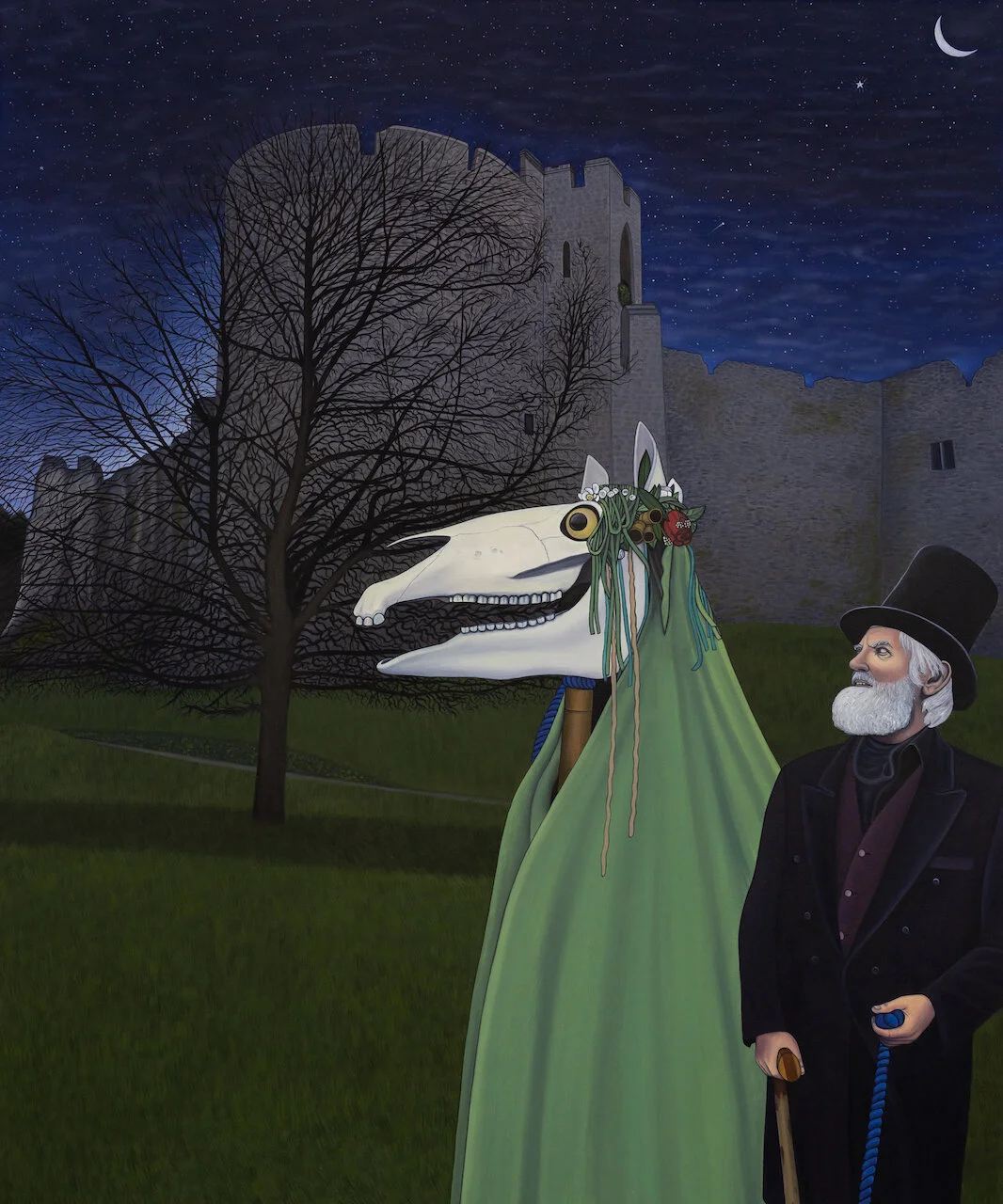
The Welsh traditional custom of the Mari Lwyd involves a Horses Skull mounted on a pole with a snapping jaw and a carrier hidden inside accompanied by a group of men that go from house to house and pub to pub, battling the inhabitants with Rhyme and song in exchange for food and drink. It is often credited as a primitive form of Carol singing that evolved from such early customs. In some instances such as in the area of Gower the skull is ritualistically buried beneath the earth and then dug up for the custom each and every year. There is a great mystery surrounding the Mari Lwyd and conflicting accounts of its origins. Many believe that it is rooted in pre-Christian and Pagan times. It is also speculated that the symbol of the dead horse miraculously coming back to life represents the death of the darkest days of winter and the approaching rebirth of spring. I attended the Chepstow Mari Lwyd festival last year where I gathered the source material and inspiration for this painting!
Oil on Canvas - 46cm X 40cm
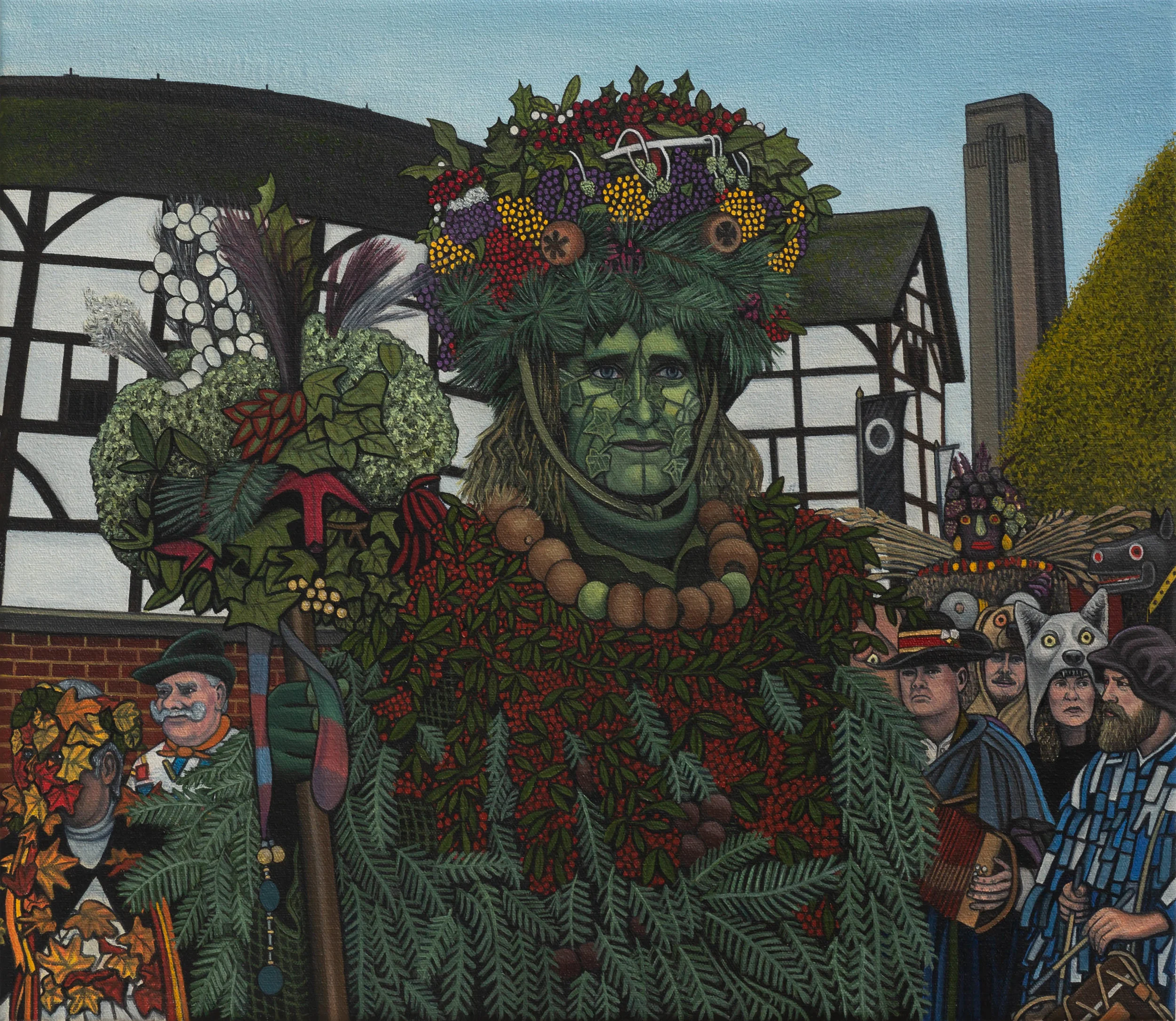
As a child my grandfather would tell me stories about the Green Man and how on a rare occasion you can catch glimpses of him walking through the woods. Iv been intrigued by the Green Man ever since and here is my painting of Londons very own Green Man of Bankside from Londons October Plenty celebrations. October Plenty is a combination of old customs to celebrate the harvest and the bounty of autumn. Like most characters of folklore, the origins of the Greenman are lost in the midst of time and widely speculated over, with some tracing the origins back to ancient cultures, where similar foliate head figures can be found, such as in Nepal, Greece, India and and Egypt. whilst others believe it to have originated in Celtic Britain, where at the birth of Christianity cult pagan deities such as the Green man were incorporated in to the symbolism of the church, to help convince worshipers of the old gods to convert to christianity.

Oil on Canvas - 65cm X 50cm
Every year on the Monday after the 4th of September the ancient ritual of the Abbots Bromley Horn dance is performed. The origins of the Horn Dance itself are a great mystery and believed by many to have taken place since Pre Christian times, originally as a fertility rite, or a hunting ritual where hunters mimicked the movements of deer to confuse them and to ensure a successful hunt. The dance is performed by the six Antler Men, a Hobby Horse, a Fool, Maid Marion, an Archer and the accompanying musicians. The horns themselves which are reindeer antlers, have now been carbon dated to the year 1065, making them not far off 1,000 years old. As reindeer were long extinct in Britain in the 11th century they must have been bought over by the Vikings from Scandinavia. Here is painting about the Horn Dance that I finished at the end of 2018.

Oil on Canvas - 110cm x 82.5cm
The Autumn Equinox is the day when the sun crosses the plane of the earths equator, making night and day of equal length. After the Equinox the days become shorter and the nights become longer, until the process is reversed, a day marked by the winter solstice. Every year on Primrose Hill the 'Druid Order' meet and perform a ritual in honour of the occasion. This painting I made based on last years ceremony, that was also an historic year, as it marked the 300th anniversary of the founding of the summit of Primrose hill as the 'Mothers Grove' and of the group itself. The poet William Blake is credited as one of the founding members of the 'Druid Order' and once wrote 'I have conversed with the spiritual sun. I saw him on Primrose Hill'.

Oil on canvas - 80 X 70 cm
Every year in the Town of South Queensferry, Scotland on the second Friday of August, the ancient folk custom of the Burry Man takes place, In which he must endure a 7 mile walk, stopping at houses, pubs and local sites covered from head to toe in sticky burrs that scratch and irritate the skin. There is much speculation surrounding the legend of the Burry man who's origins have been lost in time. Some believe it was originally a ritual to ward of evil spirits. With other theories including that the Burryman was once a sacrificial victim, a scapegoat and a symbol of fertility and rebirth. In the past the Burry man was a tradition that took place in various fishing communities across Scotland with the added purpose to 'raise the herring' when the fishing was bad. Today only this one survives. It is believed that by giving the Burry Man a whiskey in exchange for one of his Burrs that good luck will come to you for the year.

Oil On Canvas - 50cm X 42cm
The Summer Solstice is a day that marks the time of year when daytime is at its longest and night time at its shortest. This painting depicts my experience from Last years Solstice at Stonehenge. I had originally wanted to visit to get some study shots of the 'Council of British Druid Orders' that usually gather within the stone circle to perform there Summer Solstice ritual, but due to a fee of £15 now being charged in the car park, one of the leaders 'Arthur Uther Pendragon' (who believes he is king Arthur reincarnated) In protest against having to 'pay to pray' now stands outside the grounds behind a barbed wire fence, where half the druids that also refuse to enter stand with him, and the other half stand on the inside, forming a circle around the fence. having been up all night and not being able to get the source material I had originally intended, I wandered off and noticed a striking silhouette of a woman incredibly dressed standing alone, watching the sunrise. Who I later found out had come all the way from Russia. This for me echoed Stonehenge's ancient roots of being a place of pilgrimage, where pilgrims would travel from far distance's to congregate at the stones and celebrated the changing of the seasons.
Oil On Canvas - 25cm X 30cm
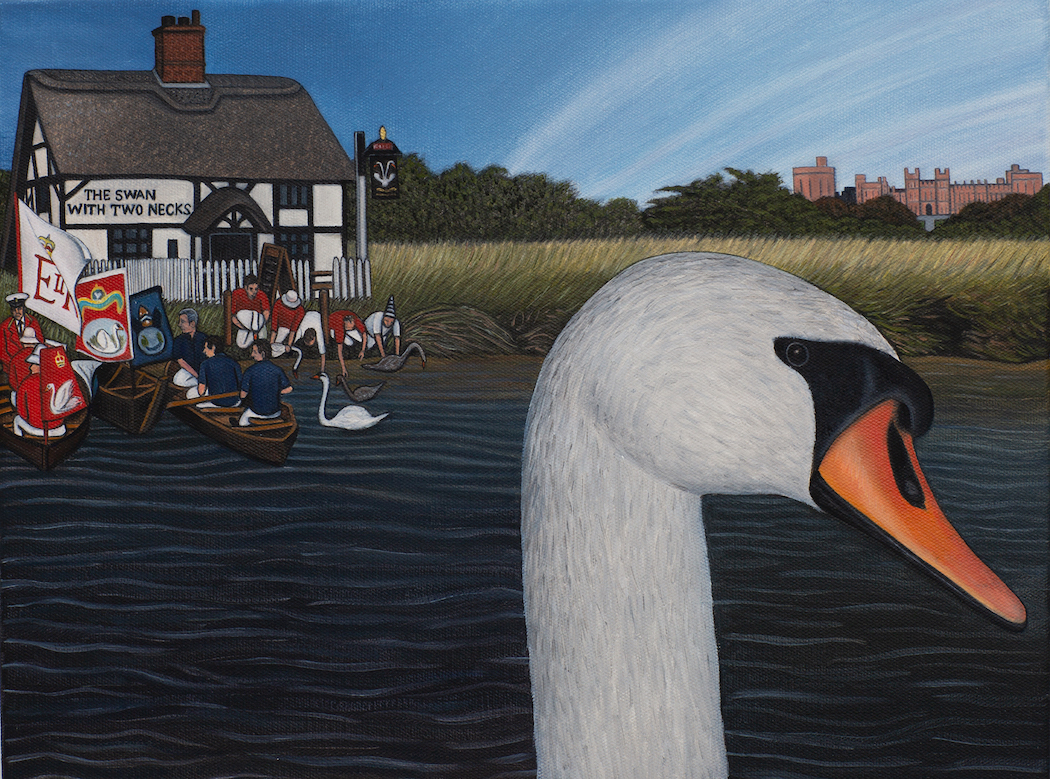
Every year in mid July, the annual 5 day ceremony of Swan Upping on the River Thames takes place. The origins date right back to the 12th century, when the Crown claimed ownership of all mute swans as they were considered a delicacy and eaten at royal banquets and feasts. In the fifteen century the worshipful company of the Dyers and the Vintners were also given the right to own swans on the Thames. To differentiate who owned which swans, markings were introduced to the beaks as a solution. Two nicks for the Vintners, One nick for the Dyers and no nicks for the Crown. The pub name, that still exists in various places today 'The Swan with two necks' evolved from the vintners 'The Swan with two nicks'. The earliest record of a royal swan heard was made in 1186 and an official office for the keeper of king swans was made in 1378.

Oil On Canvas - 75cm X 65cm
Up until the year 1859 on the 29th of May there was once an English public holiday known as 'Oak Apple Day' that commemorated the restoration of the English Monarchy in 1660. During the celebrations people were expected to wear oak apples or leaves as a reference to the Battle of Worcester in 1651, where Charles II hid in an Oak Tree escaping from the Roundhead rebel army. Anyone caught without a sprig of oak were egged, pinched or whipped with nettles. In the town of Castleton, Derbyshire a celebration still exists to this day where the Garland King on horseback leads a procession through the town dressed from head to his waist with a large Garland reminiscent of the May Day tradition of Jack in the green. It has been suggested that it could have been merged with Oak apple day from a more ancient May Day celebration that had been banned during the Interregnum period when Britains Monarchy fell and all May Day festivals were outlawed due to there non christian connections.

Oil On Canvas - 50cm X 45cm
Every year on the Saturday closest to 19th of June, the Horns of Ock street are paraded through the town of Abingdon, Oxfordshire. The tradition goes back to an event that took place in the year 1700, where there was an annual horse fair and Ox roast in the towns market square that typically ended with the 'well to do' men of the Vineyard taking the horns home with them at the end of the festivities. However on this particular year, the working men of 'Ock street' had decided it was unjust and fought with the men of the vineyard for them. After successfully winning the fight they celebrated there victory with a parade of the horns and have done so every year ever since. Later after a full day of drinking, Morris dancing and general celebration, a second tradition takes place where a Mock Mayor is elected by the residents of Ock Street, whose role is to embarrass and speak against the real Mayor when unpopular decisions are made. The Mock Mayor tradition that goes back centuries, was once common across England and still takes place in handful of towns in Cornwall and Oxfordshire.

Oil On Canvas - 50 X 44.5 cm
Every year on May Day in the Cornish town of Padstow the tradition of the 'Obby Oss' festival takes place. It's origins have been speculated over for centuries with many believing its roots lie with Pre-Christian fertility rites. The once common May Day tradition of the Hobby Horse dates back to at least the medieval period, however the Padstow 'Oss' with its unique, savage appearance is said to have evolved from a Padstow Sailor named Octavius Branton who on a voyage witnessed the 'Duk Duk' dancers of New Guinea. Returning with a mask that got introduced to the costume. Another local legend is that it began during the French Wars, when a French ship approached Padstow and with all the men away at war, a quick thinking local woman wore a mask and instructed others to disguise themselves with cloaks and to march to the cliff tops banging drum's. This resulted in a French retreat after they mistook the party to be a heathen army with the Devil at its head.

Oil on Canvas - 45cm X 45cm
Every year on what has considered to be sacred ground since Neolithic times and once known as 'The Great White Mound' a group of Neo Druids from the 'Druid Order' meet to celebrate the Spring Equinox that marks the time of the year when night and day are of equal length and to bless the land to ensure a fruitful year ahead. The ceremony is also held in London to demonstrate the Pagans belief that the City of London will eventually return back to its natural state and nature will reclaim it. This was a ritual that I observed first hand that inspired and resulted in this painting.