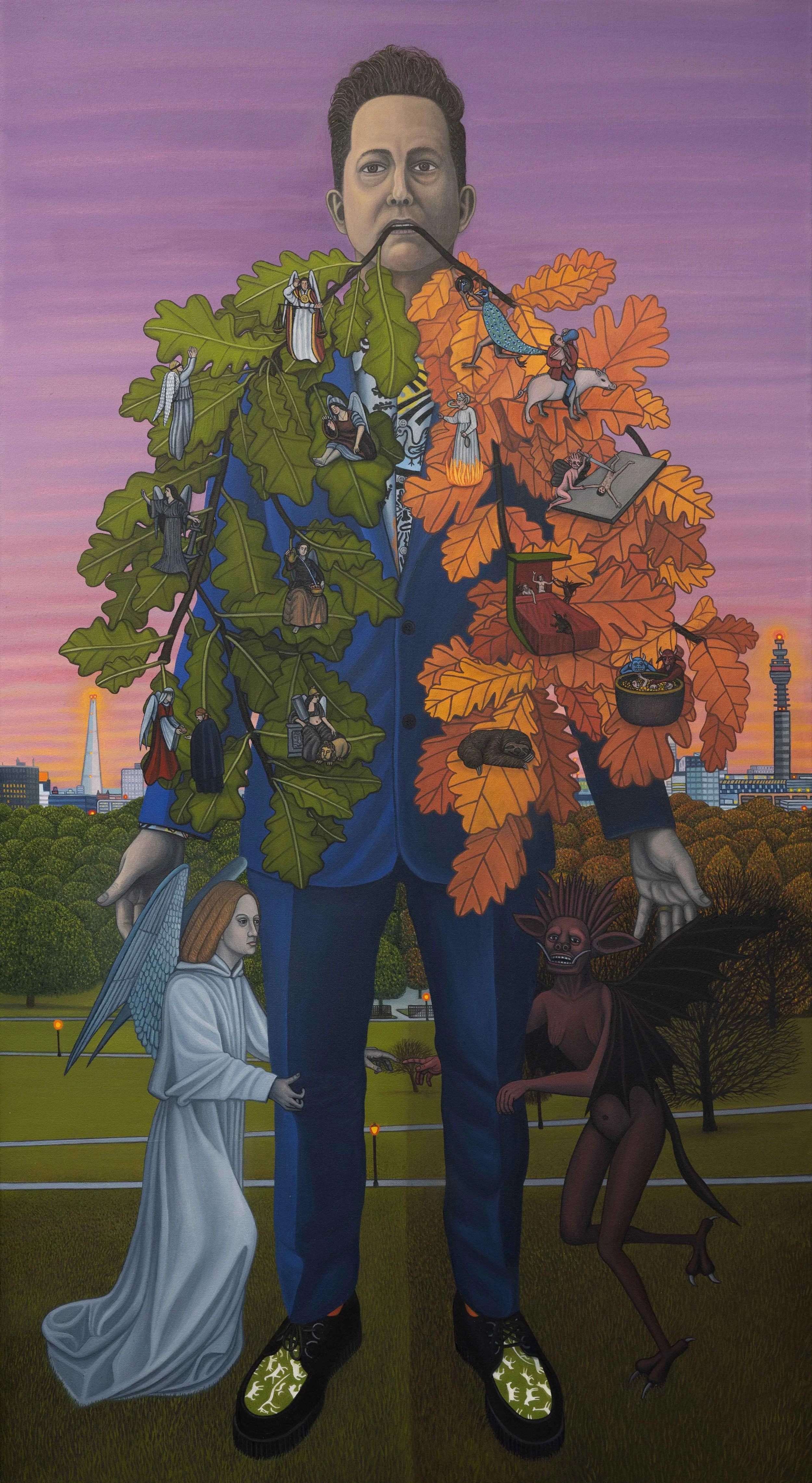
This self-portrait explores the process of shadow work and marks the end of a two year period of psychoanalysis. Shadow work is the psychological process of confronting and integrating the hidden or repressed parts of ourselves — the traits, desires and impulses we often prefer not to acknowledge.
Branching from the mouth are two oak boughs, the green spring leaves containing the Seven Virtues and the withering autumnal leaves containing the Seven Deadly Sins. At the base of the painting an angel and a demon clutch to my legs and reach toward one another, echoing the gesture from Michelangelo’s Creation of Adam. Rather than God giving life to man, the moment here suggests the meeting of light and shadow within the individual and the process of psychological integration.
As the psychologist Carl Jung wrote: “One does not become enlightened by imagining figures of light, but by making the darkness conscious.”
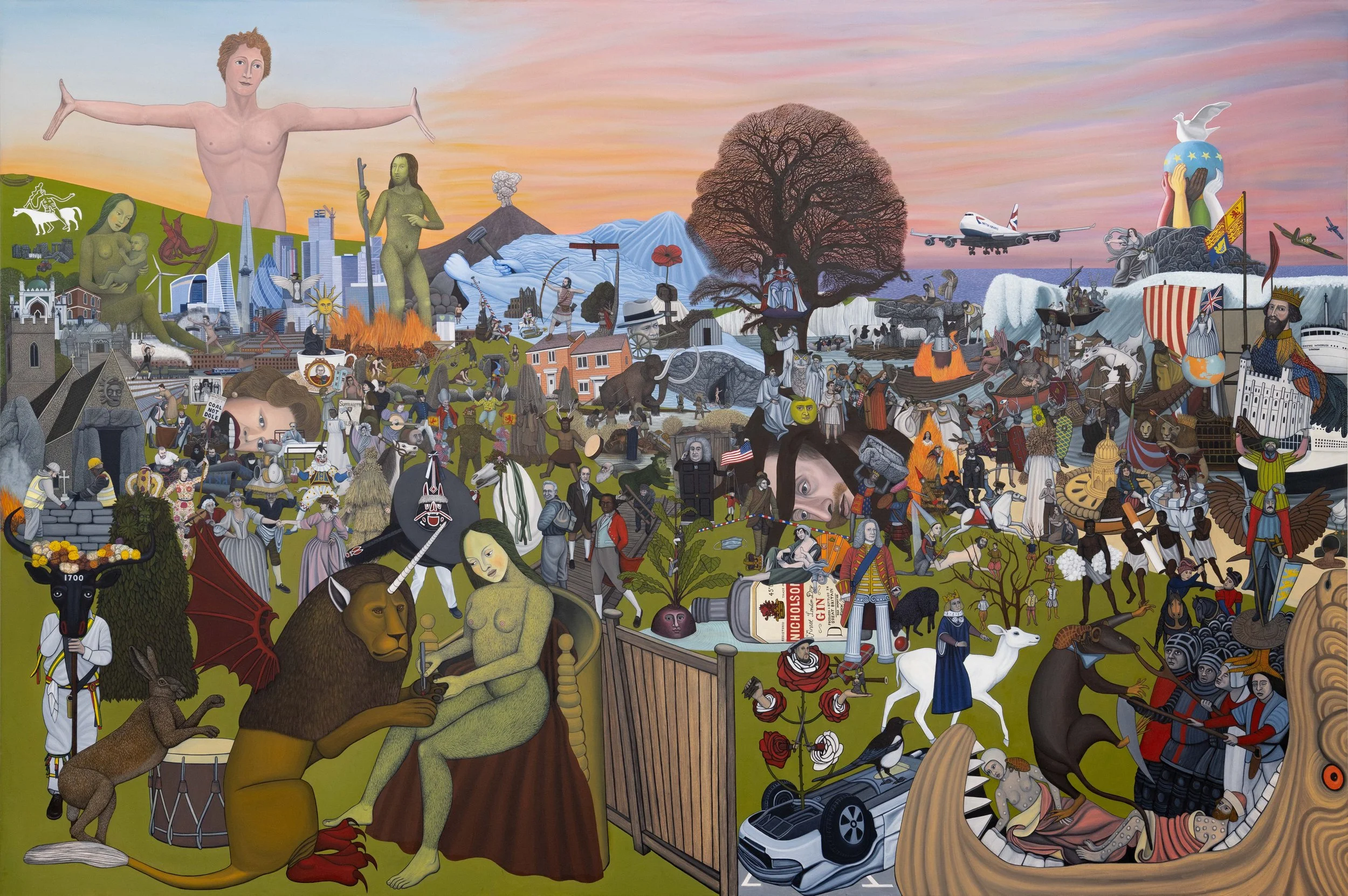
Children of Albion is a mythological history of Britain, bringing together folklore, history and imagination to explore the forces that have shaped these islands from prehistory to the present day. At its centre stands Albina, the legendary founder of Albion. According to medieval legend, Albina and her thirty-three sisters were exiled from their homeland after rebelling against their tyrannical father. They sailed across the sea to an uninhabited island, which they named Albion after Albina herself, before coupling with the spirits of the land to give rise to a race of giants, one of Britain's oldest foundation myths. Inspired by William Blake's vision of Albion as the ancient spirit of Britain, the painting reimagines this legend as a living story through which to explore Britain's evolving identity.
History unfolds simultaneously across the composition, where ancient rituals, migrations, invasions, folklore and imagined narratives become intertwined within a single symbolic landscape. Rather than presenting Britain's past as a sequence of isolated events, the painting reflects on the ways in which people, cultures and ideas continually shape one another across time. It acknowledges both the achievements and the darker chapters of our shared history—including conquest, colonialism, social injustice and the enclosure of the land—suggesting that an honest engagement with the past is essential if we are to imagine a better future.
At the heart of the painting is a hybrid figure combining the lion, unicorn and dragon, embodying Britain itself. In the distance, this creature first appears as an innocent child, cradled and breastfed by Albina, a symbolic Earth Mother nurturing the spirit of the nation at its birth. In the foreground, that same child has grown into a wounded hybrid beast, burdened by centuries of history, conflict and an increasingly polarised national identity. As a thorn is gently removed from its paw, the painting's emotional centre emerges: an act of care that becomes a metaphor for healing. Rather than portraying Britain as either heroic or broken, the work suggests that renewal begins through compassion, reflection and a willingness to confront the wounds we have inherited.
Ultimately, Children of Albion offers a hopeful vision of Britain. It imagines the nation not as something defined by the purity of its origins, but as a living culture continually shaped through migration, exchange and reinvention. By reawakening the ancient spirit of Albion through the poetic imagination, the painting proposes that our greatest strength lies not in denying the complexity of our past, but in recognising our shared humanity and our interconnected relationship with one another, the land and the living world.

Dreaming at Rudston Monolith depicts the Rudston Monolith in the East Riding of Yorkshire, the tallest standing stone in Britain, which has stood beside the parish church of All Saints for thousands of years. The juxtaposition of these two monuments speaks to humanity's enduring search for meaning, suggesting that both prehistoric ritual and organised religion are different expressions of the same encounter with the Great Unknown.
In the painting I place myself within the churchyard gazing towards the monolith, while a female figure, representing the divine feminine, is surrounded by animals as she gently cradles a hare. Separated by a band of shadow, the two figures evoke the tensions and complementarities between masculine and feminine ways of relating to the world. Above them, an echo of the Big Bang unfolds across the night sky, connecting the ancient stone, the church and the landscape to the wider story of the cosmos.

Earth Mother brings together a constellation of prehistoric monuments, folk traditions and sacred symbols to explore the enduring presence of the divine feminine within the British landscape. At its centre is a figure inspired by the Sheela na Gig of Kilpeck Church, hybridised with the form of West Kennet Long Barrow, uniting two ancient symbols associated with birth, fertility and the generative power of the Earth.
Across the surrounding hills appear a stone circle, the Green Man, the Cerne Abbas Giant and the Westbury White Horse. Together these masculine symbols emerge from, rather than stand apart from, the primordial Earth Mother, suggesting that humanity's myths and sacred traditions are rooted in the same living landscape.

100cm X 80cm, Oil on Canvas. 2023.
John Barleycorn Must Die is inspired by the harvest traditions surrounding John Barleycorn, the folkloric embodiment of the grain whose annual death and rebirth has long symbolised the changing seasons. Closely associated with the ancient festival of Lughnasadh, the tale tells of barley being cut down before returning as bread and beer, with the mischievous suggestion that John Barleycorn takes his revenge through the inevitable hangover.
The painting was inspired by a visit to the Blackthorn Ritualistic Folk Group in Herefordshire, where a towering effigy of John Barleycorn was due to be burned at the close of the celebrations. Owing to the heightened wildfire risk during an intense heatwave, the ritual was cancelled, transforming the unlit effigy into an unexpected reflection on our changing climate. In the foreground, Morris dancers stand poised with flaming torches that can no longer be used to ignite the figure, creating a poignant tension between an ancient harvest ritual and the realities of the climate crisis. Across a sun-scorched harvest landscape, harvesters, spectral figures, modern machinery and parked cars coexist, where ancient customs and contemporary life become inseparable.

The Dorset Ooser draws upon one of Britain's most enigmatic folk traditions. Originating in the village of Melbury Osmond, Dorset, the horned mask has long been associated with mystery, transformation and communal ritual. Although its precise origins remain uncertain, historical records suggest it was used in charivari customs, also known as skimity riding or rough music, where communities publicly shamed perceived wrongdoers through ritual processions involving effigies, masked figures, music and theatrical performance.
The original Dorset Ooser disappeared in 1897 but was painstakingly recreated in 1975 from historic photographs, allowing the tradition to continue. Today, it is carried each May by the Wessex Morris Men during celebrations at the Cerne Abbas Giant, while a contemporary interpretation, known as the Darkest Ooser, has been created by Jamie of the Blackthorn Ritualistic Folk Group, where it appears as a commanding beast-like presence within their ceremonies and Border Morris performances.
For me, the Dorset Ooser embodies folklore's remarkable ability to evolve across generations. While deeply rooted in Dorset, some have suggested the mask may itself have origins beyond Britain's shores, reminding us that Britain's cultural identity has never been fixed or isolated, but continually shaped through movement, exchange and reinvention. At the same time, the Ooser speaks to humanity's enduring fascination with embodying fear through ritual and performance. Beast-like figures such as this appear in cultures across the world, whether as a source of amusement, social theatre or a symbolic confrontation with the darker and more mysterious forces perceived within nature.

Oil on Canvas - 45cm X 60cm
The Devil's Den is the remnant of a neolithic burial chamber known as a ‘Dolmen’ situated on the Fyfield downs, Wiltshire, where many of the great stones were sourced by the builders of the west countries most iconic ancient monuments, including Avebury and Stone Henge.
In local folklore it is said that every night at midnight the Devil himself arrives with eight white oxen in an attempt to pull off the capstone but to no avail. A white rabbit with fiery eyes is also said to sit on top and offers his encouragement and advice. It is also local belief that if a good child runs around the Devils Den seven times that nothing will happen, but if a bad child does the same they will be met by a fire breathing toad. The Devil and stone monuments have had a long lasting association and are a reminder of a time when the church demonised the old gods and anything perceived to be associated with paganism in an ongoing campaign to convert the population to Christianity.
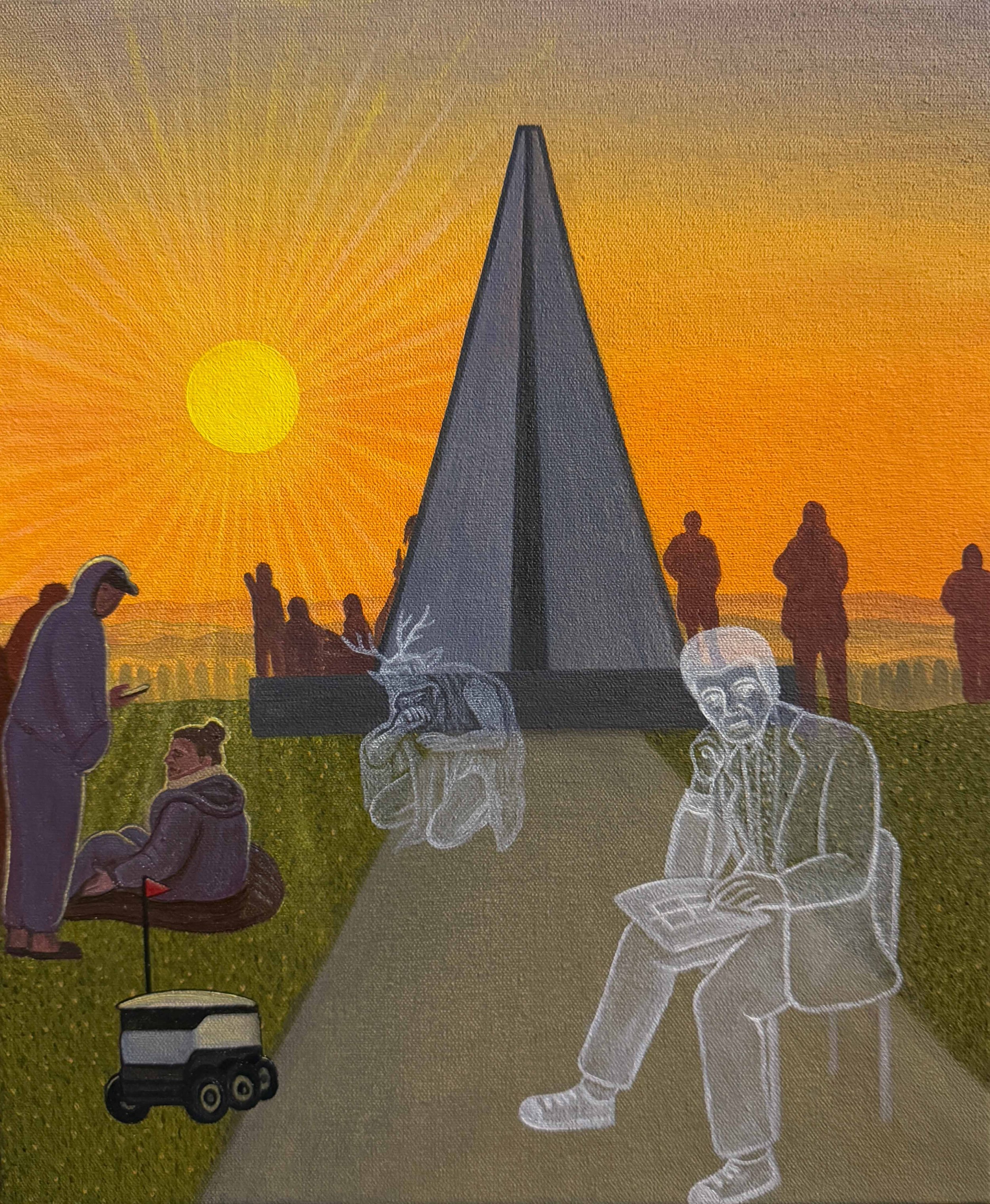
This painting depicts the rising midsummer sun over the modernist heart of Milton Keynes — a town often misunderstood, yet one designed with a remarkable sense of spiritual and cosmic intent. When Milton Keynes was conceived in the late 1960s, chief architect Derek Walker envisioned it as a “city in the forest” — a utopian place where modern life could exist in harmony with nature and light. Walker believed in the power of leylines and ancient alignments, designing Midsummer Boulevard to line up perfectly with the sunrise on the summer solstice, leading directly from the railway station to Liliane Lijn’s Light Pyramid — a contemporary sun monument overlooking Campbell Park.
Flanking the boulevard are Avebury Boulevard and Silbury Boulevard, named after the great prehistoric sites in Wiltshire — Avebury stone circle and Silbury Hill — evoking the continuity of sacred landscapes and the persistence of ancient design within the modern world.
The painting is based on my own visit to witness the solstice sunrise after reading John Higgs incredibly inspiring book ‘Watling Street’. As the first light broke between the buildings, I was struck by the quiet beauty of the scene — how something sacred can appear in the most unexpected of places.

The Risen Son at Avebury depicts one of Britain's most extraordinary prehistoric landscapes, where over five millennia of history, myth and ritual converge. As the first light of dawn breaks across the ancient stone circle, contemporary pagans gather to welcome the rising sun, continuing one of humanity's oldest shared rituals. The painting's title, The Risen Son, alludes to the enduring dialogue between prehistoric solar traditions and later Christian symbolism, suggesting that while beliefs evolve, humanity's search for meaning beneath the same rising sun remains remarkably constant.
Rather than depicting a single moment in time, the painting allows history to unfold simultaneously. Neolithic monument builders stand alongside the medieval villagers who dismantled many of the stones for building materials, while the archaeologist Alexander Keiller, whose pioneering excavations and restoration returned much of Avebury's stone circle to the landscape, is acknowledged alongside a ley-line dowser searching for the Earth's hidden energies. Nearby, a woman sits upon one of the monument's fertility stones, while the Devil occupies the famous Devil's Chair, reflecting the transformation of a sacred site as pagan traditions were gradually reinterpreted through a Christian worldview. The legendary Giant of Avebury also makes an appearance, recalling the local tale that he was so tall he could pass pints from the Red Lion—the only pub in the world situated within a stone circle—to the upstairs windows.

Oil on Canvas, 25cm x 30cm
The Rollright stones is a stone circle on the Oxfordshire Warwickshire border and it was here that the pioneering 18th century antiquarian William Stukeley had a life changing experience in which he first had the thought that stone circles such as the Rollrights were the temples of the ancient Britain’s built by the Druids. This inspired him to obsessively investigate and document the ancient monuments of Britain. Stukeley’s work later became the main inspiration for William Blake to write his iconic hymn and alternative national anthem ‘Jerusalem’ that was about his romantic desire to rekindle Druidic culture in Britain. It turns out that although Stukeley was right in dating the stones to pre-roman times, the stones are actually much older and date back to the late Neolithic early Bronze Age period.
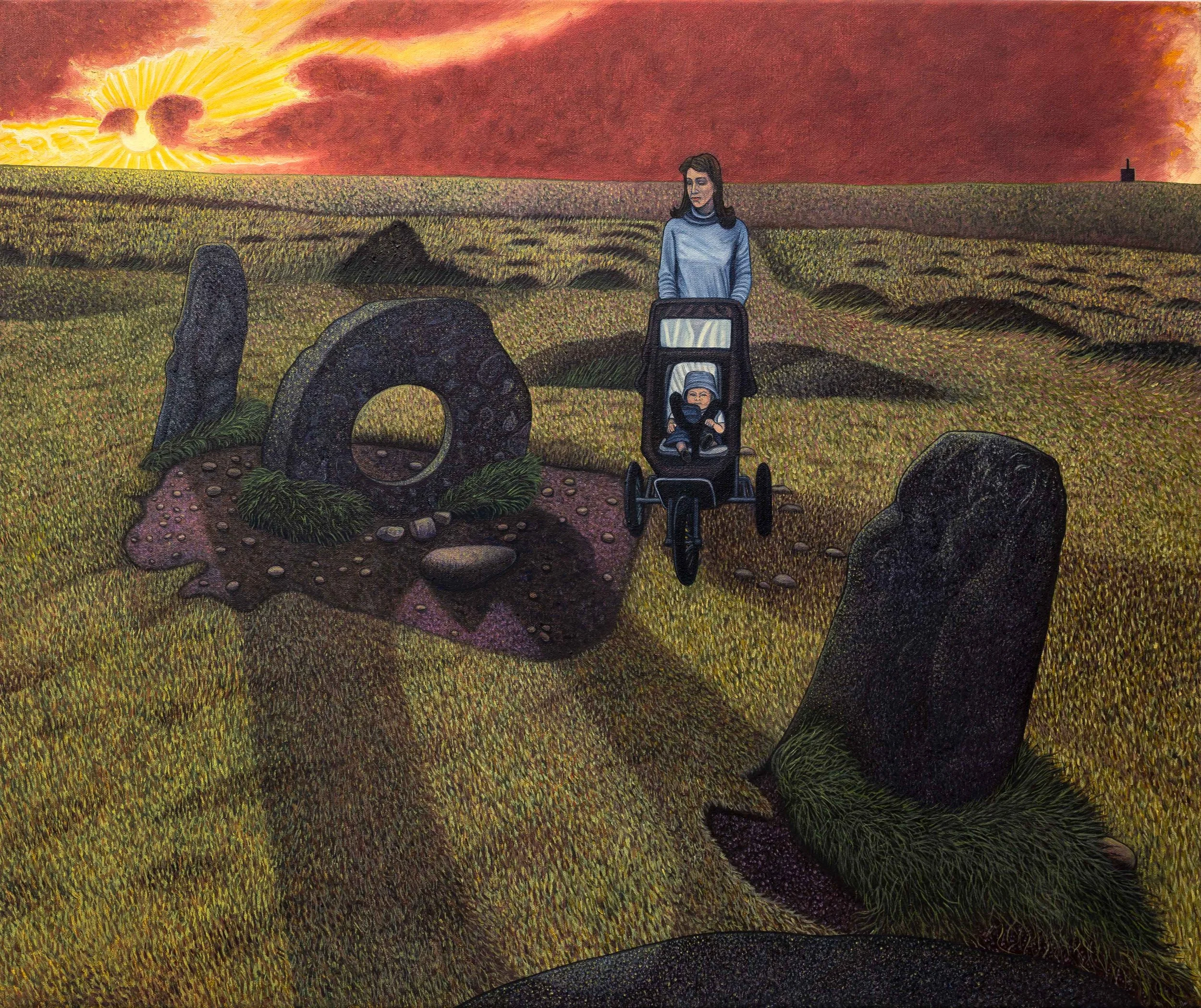
MEN-AN-TOL (2022)
Oil on Canvas, 50cm x 60cm
Mên-an-Tol is a Cornish Bronze Age stone monument in which the centre stone contains a near perfect round hole that according to local folklore is said to have the powers to heal children of rickets if passed through naked nine times, the holed stone also interpreted as a feminine symbol was once believed to aid woman in fertility if they were to crawl through it backwards at the time of the full moon.

Oil on canvas - 55cm x 40cm
This is a self portrait that I made after completing my Frontline Folklore series. I depict myself as the Green Man a mythical figure that appears in both Pagan and Christian symbolism. A figure that to me represents the cyclical nature of death and rebirth, the seasons and our severed connection to nature as a species. The Green man reminds us that we are part of nature and most importantly not above it. I also feel as an artist that the act of art making and creativity itself is an extension of nature and through channelling our own individual personalities, we create unique art specific to ourselves and unique to the world.
Within the painting I make references to my own life. In the backdrop we see the city of London, from Parliament Hill, a site believed to have been named by the Druids as Llandin, and part of an ancient spiritual complex that includes stone circles on the sights of St Pauls Cathedral and Westminster Abbey and potentially where the cities name derives. It was also a Roundhead stronghold during the civil war and the reason why it was renamed Parliament hill. Its relevance to me personally is the fact that London has been the place that I have spent the majority of my life and this site in particular is a place that I visit almost daily on my way to swim at the Hampstead Ponds.
To the left we see the legend of St Dunstan and the devil, an early piece of folklore that I heard that has stuck in my mind and inspired me. At a young age my parents separated, I spent my weekends and holidays with my father in Shoreditch, East London and the majority of my childhood with my mother in the town of Southborough, Kent, close to the Kent Sussex border where this piece of Folklore is said to have unfolded. According to the legend, St Dunstan ended up in the East Sussex town of Mayfield after his conversion to Christianity working as a blacksmith. One day the devil confronted him enraged by the good work that he was doing for Christianity and disguised himself as a beautiful young woman and tried to seduce him, whilst dancing around and not managing to catch his gaze. One of his hooves was seen from beneath his dress, Dunstan instantly took the pair of red tongues that he was holding and clamped them onto the devils nose. In agony the devil could be heard screaming as he ran all the way to Tunbridge Wells where he spotted a natural spring and plunged his nose into the waters. This is the reason for the irony sulphur taste that can still be tasted to this day in the towns famous spring waters.
On the right hand side of the painting I capture the moment in which a new idea was born when I witnessed a Druid ceremony (accidentally) on Tower Hill on the day of the Spring Equinox. From this serendipitous experience my whole Frontline Folklore series blossomed and manifested itself. A truly inspiring moment that lead to a life changing folkloric journey across the British Isles, a series of paintings and a documentary film that was exhibited in June 2021 at the Crypt gallery alongside the Museum of British Folklore collection.

Oil on canvas, 12” x 10”
Bryn Celli Ddu translated into English means ‘the mound in the dark grove’. This chambered tomb in Anglesey, that aligns with the rising Sun of the summer solstice was originally built in Neolithic times and would have been a significant place of ancestor worship. Anglesey itself has great significance in the story of the Roman conquest of the British Isles. By the year 50AD the Romans had pretty much eliminated the Druidic culture. All strongholds had fallen with the only remaining one being Anglesey in North Wales. Here the Druids took their final stand against the Roman legion where general Gaius Suetonius Paulinus wrote "On the shore stood the opposing army with its densest array of armed warriors. Between the ranks dashed women, attired in black like the Furies with their hair dishevelled, waving burning brands. All around them were Druids lifting their hands to heaven and pouring forth dreadful implications. Our soldiers were so petrified by the unfamiliar sight that as if their limbs were paralyzed, they stood motionless, exposed to wounds. Until at last, urged by their general not to quail before a troop of frenzied women, they bore the standards onward, smote down all resistance, and wrapped the foe in the flames of his own brands." As the Druids took their final stand and fell to defeat, women, children and men were all unmercifully massacred by the colonialists and thrown onto makeshift funeral pyres.

Oil on canvas, 100cm x 150cm
The Stones of Stennes have stood in the heart of Orkney since Neolithic times, with evidence of work beginning in 3,100 BC, are speculated to be the oldest stone circle in the British Isles and where the nationwide standing stone cult began. It was noted right up until the the 19th century that a stone known as the Odin Stone, that was unfortunately destroyed by a farmer in 1814 due to his resentment of the trespassing of his land, was used in engagement ceremonies where couples would hold hands through the holed stone. Other magical rituals were also performed where people made oaths and promises and a 'Vow of Odin'. Today a residential home named ‘Odin House’ stands close to the circle as a surviving spectral reference.
The Ring of Brodgar, a nearby monument that is third largest stone circle in the British Isles and part of the same Neolithic complex was built 500 years later. Twenty seven of the original sixty stones survive today. Each stone comes from a different area of Orkney, which highlights the different tribal communities that came together, united by the building of the monument. An old tale connected to the ancient site tells the story of a party of giants that once gathered accompanied by a fiddler to sing and dance. As the revellers danced hand in hand through the night, they lost track of time and as morning came on the holy day of the sabbath, the unfortunate group were turned to stone as a punishment by God.
Another stone known as 'The Watch Stone' that is situated with the Neolithic Complex is said to come alive every year at midnight at the time of Hogmany (New Years) to take its annual drink from the loch. Other local beliefs include the Selkie folk, a type of hybrid human seal that can transform into beautiful humans, seducing people from the land in to the waters.

The Turning of the Devil's Stone is inspired by the annual ceremony held in the village of Shebbear, Devon, where each year on the 5th of November villagers gather to turn the Devil's Stone using crowbars following a day of Morris dancing.
According to local legend, a great battle once took place between God and the Devil. During the struggle, the Devil lost his footing, dropping the stone and trapping himself beneath it. It is said that over the course of a year he slowly tunnels his way beneath the earth, only to be imprisoned once more when the villagers return to turn the stone, ensuring another year of peace and prosperity for the community.
The stone itself has long added to the mystery. Geological analysis suggests that it originated from outside the British Isles, leading to speculation that it may once have been a meteorite echoing the legend, although it is now generally thought to have been transported to Devon during the Ice Age.

Oil on Canvas. 30cm X 25cm
On a scorching summer’s day, I visited the Long Man of Wilmington, where the yellow-hued grass shimmered under the sun and the figure gleamed from the hillside. In the distance, the ears of a hare emerged, evoking folklore stories of Old Mother Venus, a shape-shifting witch who transformed into a hare. Other local legends spoke of the Long Man’s health-bringing powers and suggested a medieval monk etched the figure. The hill itself, aligned with a LeyLine, is said to depict a leyline hunter.
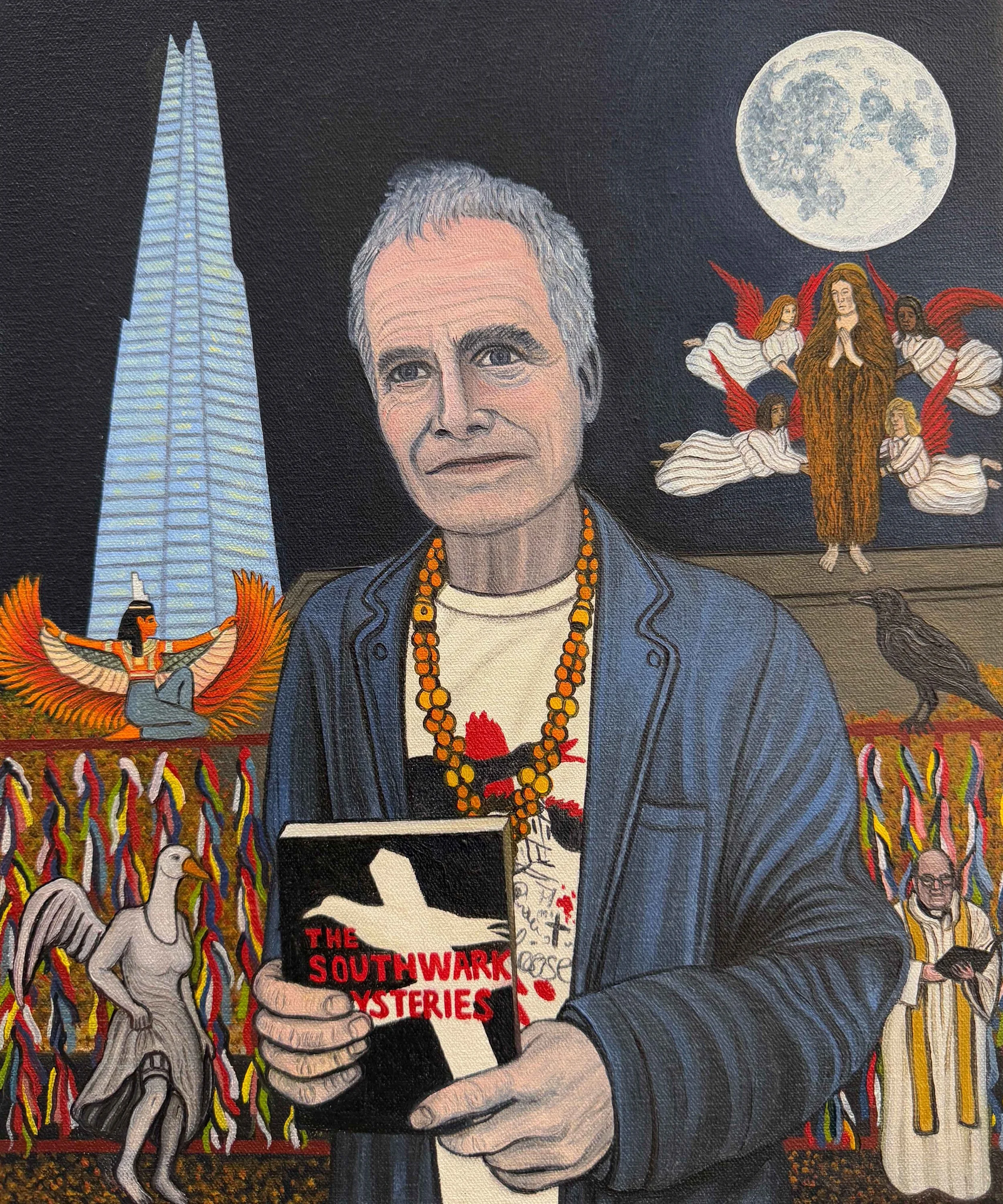
November’s full moon, the Mourners’ Moon, rises over Crossbones Graveyard — the formerly unconsecrated burial ground on Redcross Way where the “Winchester Geese”, the outcast women and sex-workers licensed by the Bishop of Winchester to work in the Liberty of the Clink, were laid in unmarked graves despite their service in life.
On the night of 23rd November 1996, the writer John Constable (whose alter-ego is known as John Crow) experienced what he described as a shamanic vision. In that moment he felt visited by the spirit of “The Goose” — the protector and spirit of the buried women — which led him to the gates of Crossbones and inspired the cycle of poems and mystery plays known as The Southwark Mysteries.
For more than twenty years he has campaigned to protect the site, resisting property developers and keeping the memory of the outcast dead alive. His work has helped shape Crossbones into a memorial not only for those particular women, but for all those buried at the margins, denied dignity in life and death — and also as a place of belonging for the outcast living, those who have never quite fitted the categories imposed by society. Each month on the 23rd, vigils are held at the gates in their honour.
Every year, on the Sunday nearest the Feast Day of Mary Magdalene (22 July), clergy from Southwark Cathedral lead the annual ceremony known as the Act of Regret, Remembrance & Restoration. A procession walks from the Cathedral to Crossbones, where those gathered express sorrow for past wrongs, remember the buried outcasts and children, and pledge to honour them in the present.
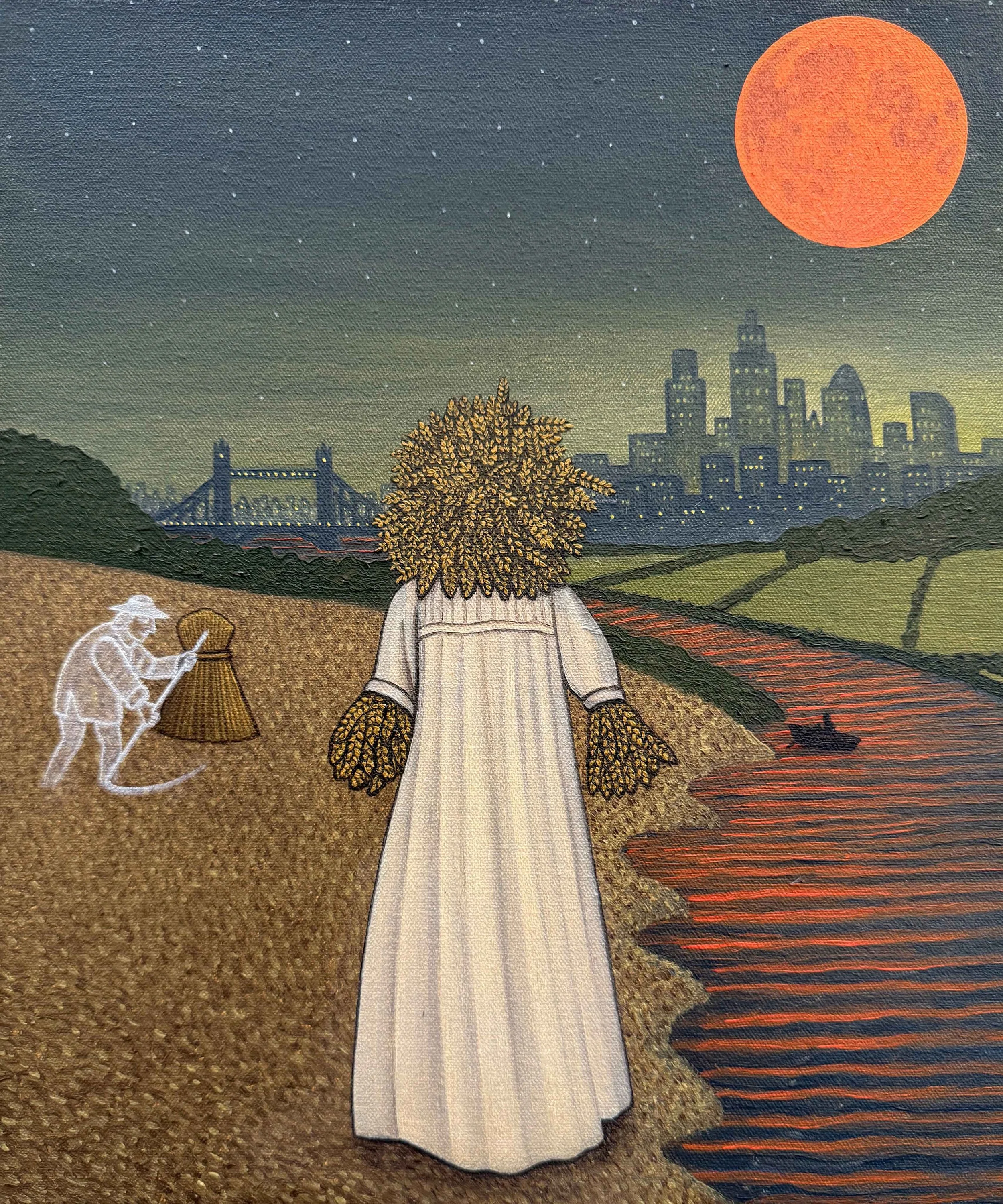
September’s Harvest Moon rises low and bright, once giving farmers precious extra hours to bring in the last sheaves before the year turned.
Across Britain, the final sheaf was bound into a Kern Baby—sometimes called the Cailleach, the Old Woman of the Fields. Cut down yet kept alive through winter, sometimes burnt and scattered to ensure renewal, it carried the belief that death must always hold the seed of rebirth.
In my painting, the Kern Baby stands in the stubble under the Harvest Moon. A spectral harvester gathers the last corn. The Thames flows toward a glowing London, while a solitary ferryman drifts on the water.
In Jungian terms the Kern Baby is the Child archetype, fragile yet enduring, while the harvester embodies Death. Between them lies the eternal cycle of sacrifice and renewal.

Oil on Canvas, 25cm x 30cm
Tonight marks what was once known to the ancients as the Full Mead Moon, now more commonly called the Strawberry Moon. June takes its name from Juno, the Roman goddess of marriage and protector of women. June’s full moon rises at the height of midsummer, when the days are longest and the nights are shortest, a time when people would gather to celebrate the summer solstice. It is also traditionally the month for weddings, a season of union and new beginnings.
From the early medieval period, and likely long before, couples used holed standing stones in their wedding ceremonies, joining hands through the stone to make their vows. Mead, made from fermented honey, was then drunk by the newlyweds during the first moon after marriage, giving rise to the word “honeymoon.” Mead carried deep associations with fertility, magic, and sacred union.
In medieval times, bees were seen as messengers to the spirit world, and beekeepers often monks were regarded as sages, keepers of ancestral knowledge rooted in the cycles of nature and time. The beehives themselves were kept informed of births, marriages, and deaths in a tradition known as 'Telling the Bees'.
In Jungian psychology, the Sage archetype embodies this role of wisdom and guardianship, the quiet passing down of knowledge and a deep connection to the rhythms of nature and ancestry.

Oil on Canvas, 100cms X 80cms
Boss Morris are an all girl Morris dancing side that formed in 2015, Stroud, Gloucestershire. Their unique approach that merges contemporary pop culture with ancient symbolism, folk art and traditional Morris dancing has sparked a new wave of Morris dancing known as 'Prog Morris' with Boss Morris very much at the forefront and pioneers of this new movement. As well as performing their own newly invented rituals that still coincide with the ancient wheel of the year Boss Morris also dance at long established traditional events and folk festivals. In 2022 I visited their hometown of Stroud in Gloucestershire on the Spring Equinox for a private ceremony to gather source material for this painting. I was interested in the Equinox as a time of balance. With the Equinox marking the time when night and day are of equal length, I saw this as a metaphor for how Boss Morris inspire us to rebalance ourselves with nature, creativity and feminine energy.

Oil and chalk from the Uffington White Horse on Canvas, 30cms X 25cms
The Vale of the White Horse runs between the ancient Ridgeway trackway and the River Thames across the Cotswolds (once part of Berkshire) in Oxfordshire. The Uffington White Horse itself is the oldest hill figure in Britain and is situated on the slopes of White Horse Hill and is said to date at the earliest from 1380 BC. The horse is believed to represent a tribal symbol and could have been built by the builders of Uffington Castle or at least maintained by them. Other theories suggest that with it facing to the sky instead of being positioned further down the slope to help it be seen from great distance that it represents the sun horse. In the Bronze Age it was believed that the sun was drawn through the sky on a chariot pulled by a divine horse. For the horse to have survived this long in time it must be scoured and re-chalked and a festival known as ‘Pastimes’ that took place up until 1857, was once held on the hill at the time of the Summer Solstice, in which locals were said to have believed to go all the way back to Saxon times. The actual chalk of the White horse is mixed within the oil paint within this painting that I collected from the chalking of 2022.
Close to White Horse Hill you will also find the Neolithic chambered long barrow Wayland's Smithy that has been dated to 3600 BC. According to local folklore it is said that if a traveller was to lose a horse shoe to take their horse to Wayland’s Smithy and to leave it over night with a piece of money and by daybreak the horse will be fully heeled and the money gone. It’s also said that the nearby Uffington white horse will disappear on occasion (most commonly under the guise of snow) as it’s made it’s way to Wayland’s Smithy for some new horse shoes. The legend of the black smith aka ‘Weyland’ derives from a Norse legend of a smith of exceptional, supernatural skill who the Anglo Saxons called ‘Weyland’ and believed the long barrow to be his home.
My wife that I have depicted within the painting is from the near by market town of Faringdon that lies within the Vale and the symbol of the Uffington White Horse was used as the logo of her infant school uniform.

Doc Rowe is one of Britain's foremost folklorists and has spent more than six decades documenting the seasonal customs, rituals and celebrations of Britain. Through thousands of hours of film, photography and sound recordings, he has created one of the most significant archives of British folk culture ever assembled, preserving traditions that might otherwise have been lost.
The Isle of Doc Rowe presents the folklorist within a hybridised landscape shaped by his life's work. Drawing together references to customs from across Britain, the painting becomes a symbolic life map in which people, places and traditions coexist within a single imagined environment. Alongside these folk figures are references to the cameras, recording equipment and technologies that Doc has enthusiastically embraced throughout his career, reflecting his lifelong fascination with documenting the rapidly changing world around him.
The painting was created alongside and features in the documentary film The Archivist, which follows Doc's extraordinary life and work, celebrating his enduring contribution to the preservation of Britain's living traditions.
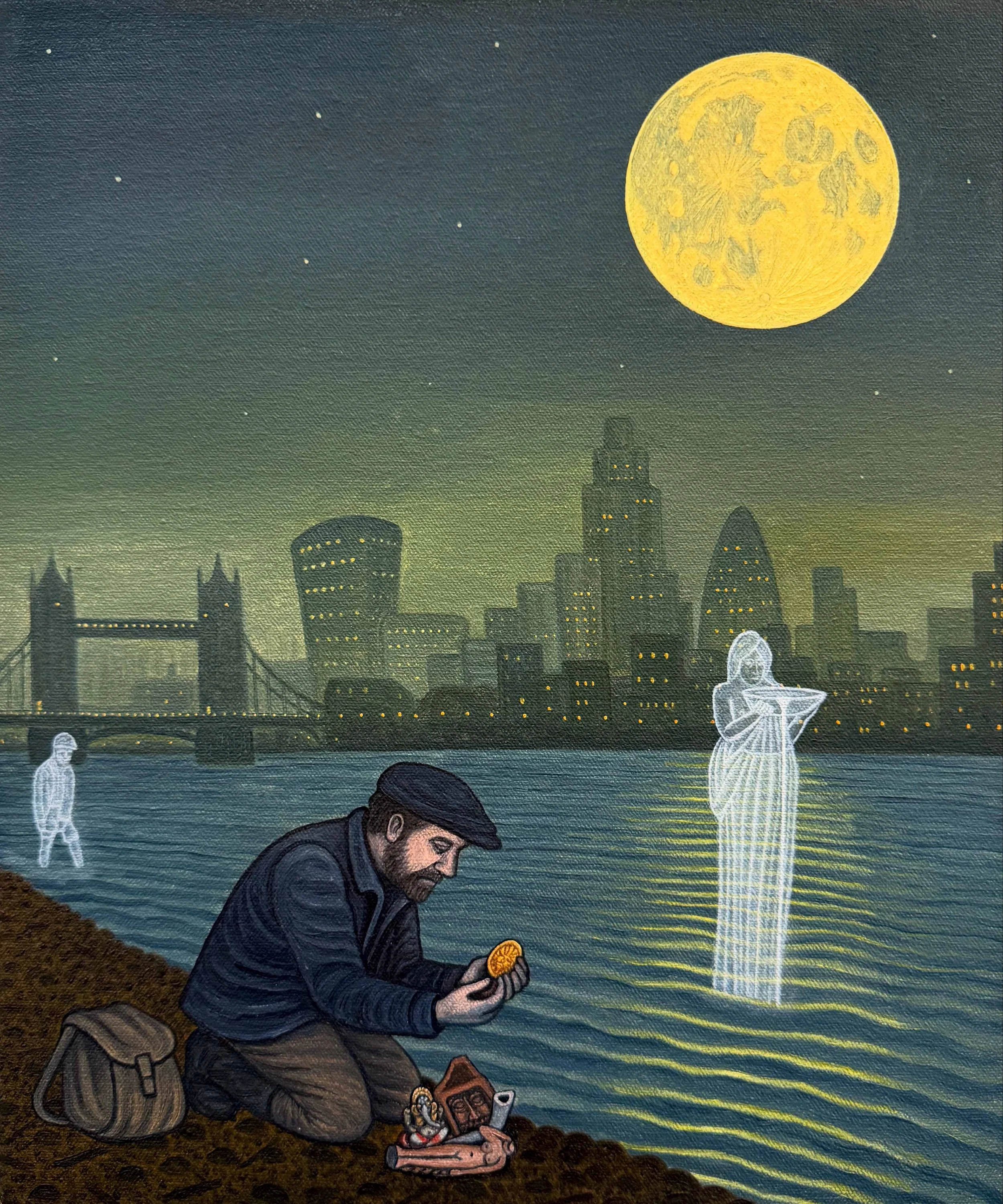
MOONLARKING AT FULL GRAIN MOON, Oil on Canvas, 30cm X 25cm, 2025
Augusts full moon is known in old farming almanacs as the Grain Moon, marking the start of the wheat and barley harvest. August takes its name from Augustus Caesar, first Roman emperor, who secured Rome’s grain-rich lands in Egypt. Though he never set foot in “uncivilised” Britain, he inherited Julius Caesar’s ambition to bring the island under Roman influence, setting the stage for conquest less than 70 years later. In time, Britain’s fields fed Rome’s vast grain network—another thread in the long history of land and harvest bound to empire.
Under this moon, Moonlarkers—or mudlarkers—search the Thames foreshore revealed by the moon’s pull. Offerings to the river date back to the goddess Tamesis, later replaced by Old Father Thames—a shift from feminine divinity to patriarchal imagery. Yet the river’s feminine presence endures. Finds today include Hindu deities placed by modern Londoners and figures of the Virgin Mary, a Christian echo of older goddesses.
In Victorian times and earlier, groups of poverty-stricken children scoured the foreshore for items to sell. In Jungian psychology, the Seeker archetype searches the past to recover what has been lost. Mudlarking is time travel in miniature—each object, whether medieval badge, ancient coin, or clay pipe, carries the imprint of human lives before sinking into the silt to be found again centuries later.

Oil on Canvas - 130cm x 100cm
Mummers plays are a type of folk play performed by amateur actors that can be traced back to at least 1296 where the earliest reference can be found, stating 'Mummers of the Court' along with 'Fiddlers and Minstrels' performed at Edward the 1st's daughters wedding. Mumming a type of guising in which the identity of the participant is often concealed traditionally were performed by working men that couldn't find employment through the tough months of winter and took to entertaining crowds in return for beer, money and food. The themes of the plays are often themes of death and resurrection relating to the transitional, cyclical nature of the seasons and the biblical story of Jesus.
I based this painting on a photo of the Alderley Mummers taken in 1920 from the Mary Houseman, Private Collection. All the Alderley Mummers were related, members of the Barber family, a large and well-established family centred around Brynlow Farm, tenanted land on the Alderley Park estate. Alderley Park was the family seat of the Lords Stanley they began performing the play at Alderley Park in the early 19th century and continued until 1937, when the estate was broken up and sold. Four generations of Barber family performed in front of six different Lord Stanley’s as part of the Christmas time celebrations.

Oil on Canvas, 30cm x 25cm
The Hooden Horse, a wooden horse head mounted on a pole with a sack cloth draped over the wearer, is part of a folk custom known as hoodening unique to Kent, In which a group of villagers during the lead up to Christmas perform a folk play with themes of death and resurrection at local pubs and private parties. Originally only found in East Kent, although it relates to a wider spread tradition throughout the British Isles in which ‘Hooden animals’ often horses are paraded as part of seasonal themed rituals. The Hooden Horse tradition itself is believed to have originated with unemployed farm labourers, who during the hard months of winter, found creative ways to entertain crowds to earn money, beer and food. Going further back in time it has been suggested that the word ‘Hooden’ relates to the Anglo Saxon god Woden. This specific Hooden Horse named ‘Satan’ is part of the St Nicholas-At-Wade Hoodeners, the painting was inspired by a visit I made to witness the custom in December 2022.

Oil on Canvas - 25cm x 20cm
This painting captures the moment in which a new idea was born when I witnessed a druid ceremony (accidentally) on Tower Hill on the day of the Spring Equinox. From this serendipitous experience my whole Frontline Folklore series blossomed and manifested itself. A truly inspiring moment that lead to a life changing folkloric journey across the British Isles, a series of paintings and a documentary film that was exhibited in June 2021 at the Crypt gallery alongside the Museum of British Folklore collection.
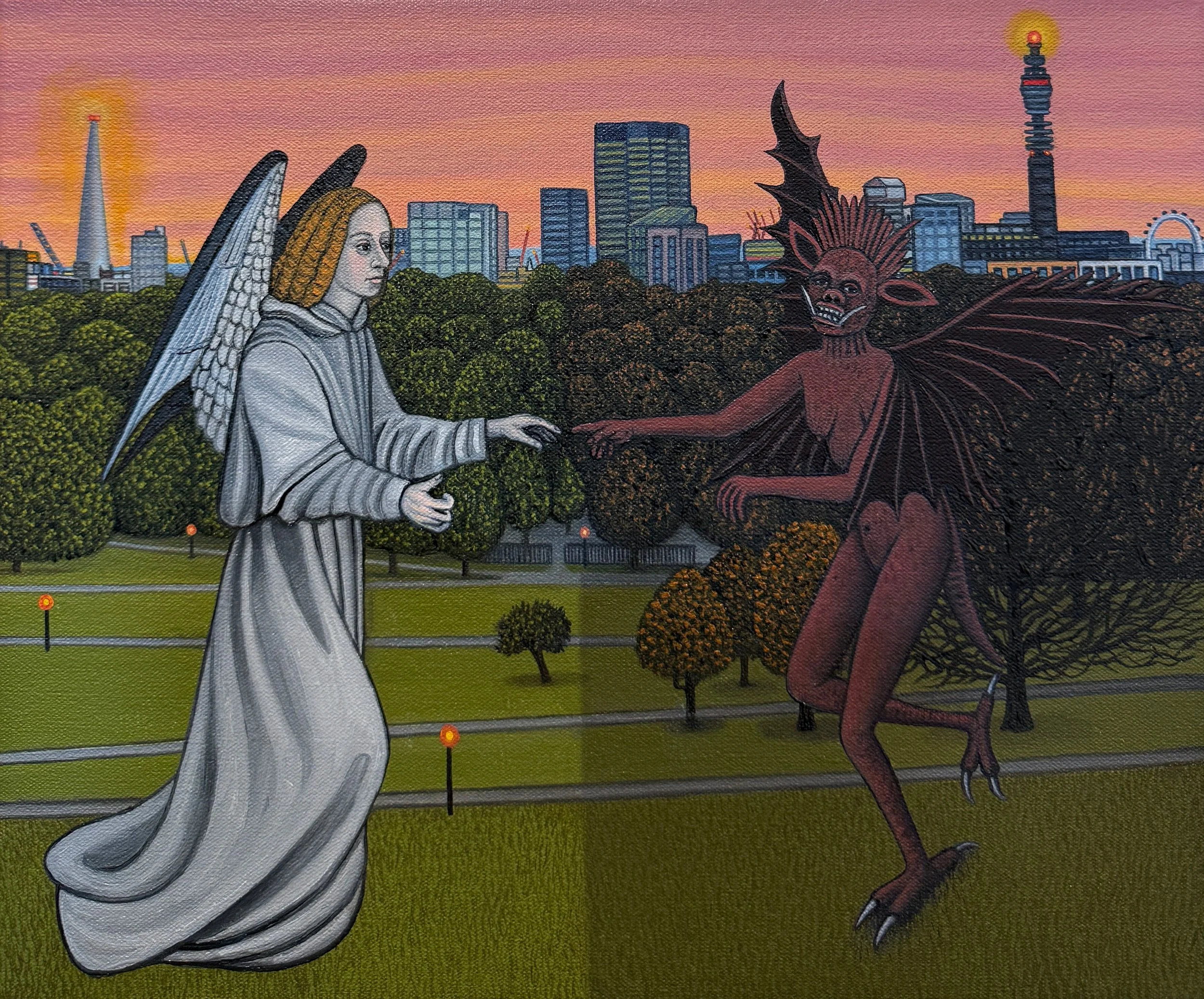
The painting is set on Primrose Hill, a place closely associated with William Blake, this painting draws on the visionary spirit of The Marriage of Heaven and Hell and Blake’s own declaration: “I have conversed with the spiritual Sun. I saw him on Primrose Hill”
The landscape is divided between winter and spring, one half skeletal, dormant and stripped bare, the other alive with growth, blossom, and renewal. A devil and angel emerge within this shifting terrain, embodying the tension between opposing states of being, decay and vitality, darkness and light.
The work explores the unsettling yet generative relationship between death and rebirth the necessary law of existence that nothing can flourish without something first dying and the tragedy and beauty in this cycle.
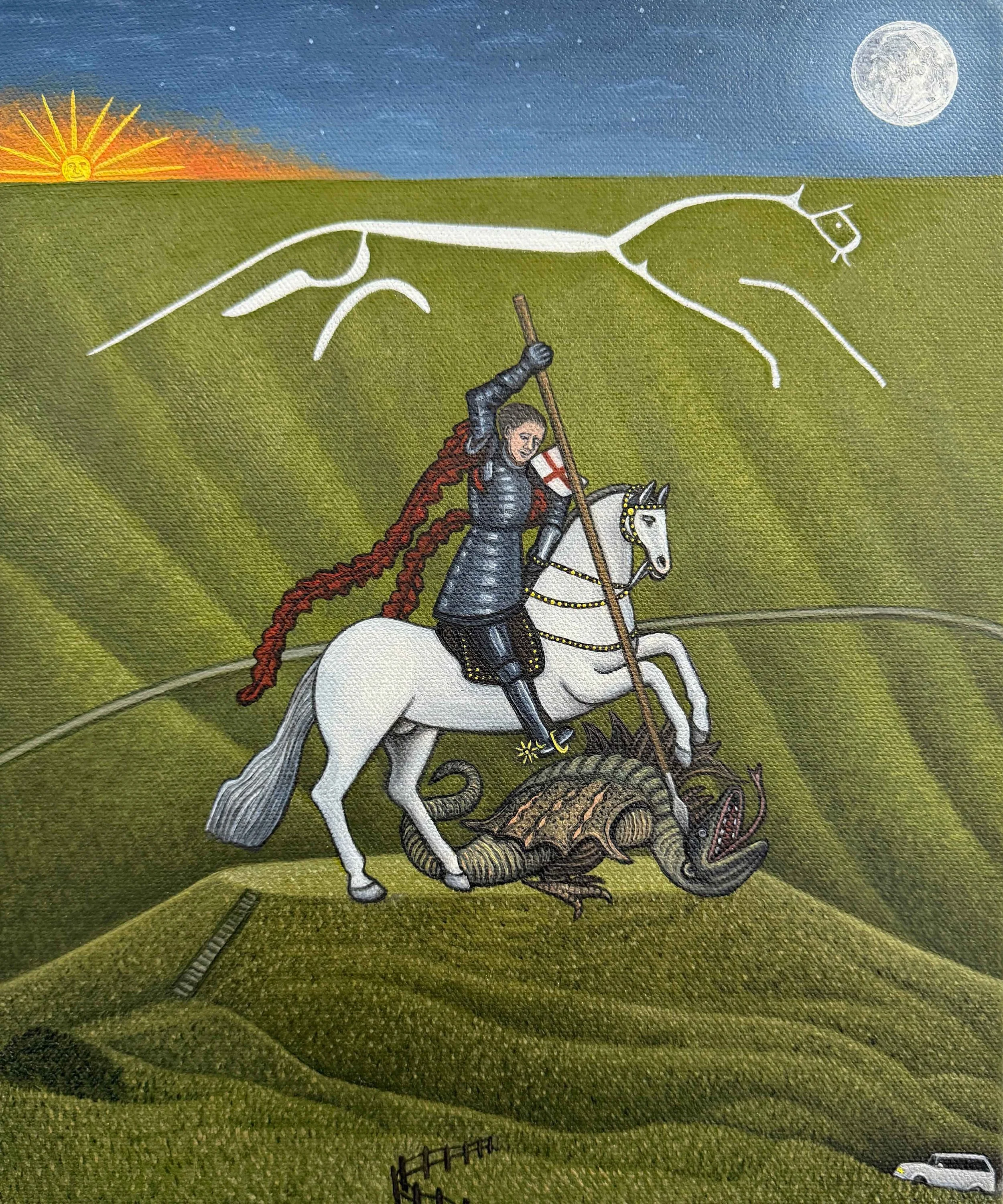
July’s full moon is known in some traditions as the Horse Moon. A name found in both June and July in different instances. The month of July was named after Julius Caesar. It was Caesar who first sought to conquer the wild Britons of Albion, writing that “all the Britons dye themselves with woad, which gives them a blue colour and makes them more terrible in battle.”
In Celtic and pre-Roman Britain, horses were revered as sacred beings. They were linked to fertility, the Otherworld, and the turning of the seasons. Horse burials have been found alongside high-status individuals. Deities such as Epona and Rhiannon rode between worlds. The Uffington White Horse, carved into the chalk over three thousand years ago during the Late Bronze Age, is thought to represent a solar horse. One that pulled the sun across the sky in ancient belief.
The story of Saint George, one of the most enduring legends in England, seen in our flag and mummers play tradition. The legend of a maiden who is chosen as a sacrifice to a fearsome dragon that has plagued her land. As she stands at the edge of death, George appears on horseback, slays the beast, and saves the people. In time, the people are baptised, and the land is transformed. The site of Dragon Hill, which sits below White Horse Hill, is where English folklore says the battle took place. A bare patch of chalk on the summit, where no grass will grow, is said to be the spot where the dragon’s blood scorched the earth. It remains visible to this day.
Beneath the surface, the tale holds older meanings. The dragon George faces is not just a monster, but a symbol of chaos, fear, and the wild, uncontrollable forces of nature. In confronting it, George steps into the role of the archetypal hero. The one who must face the shadow to bring balance. As Jung wrote, “the hero is he who conquers the dark powers of the self.”
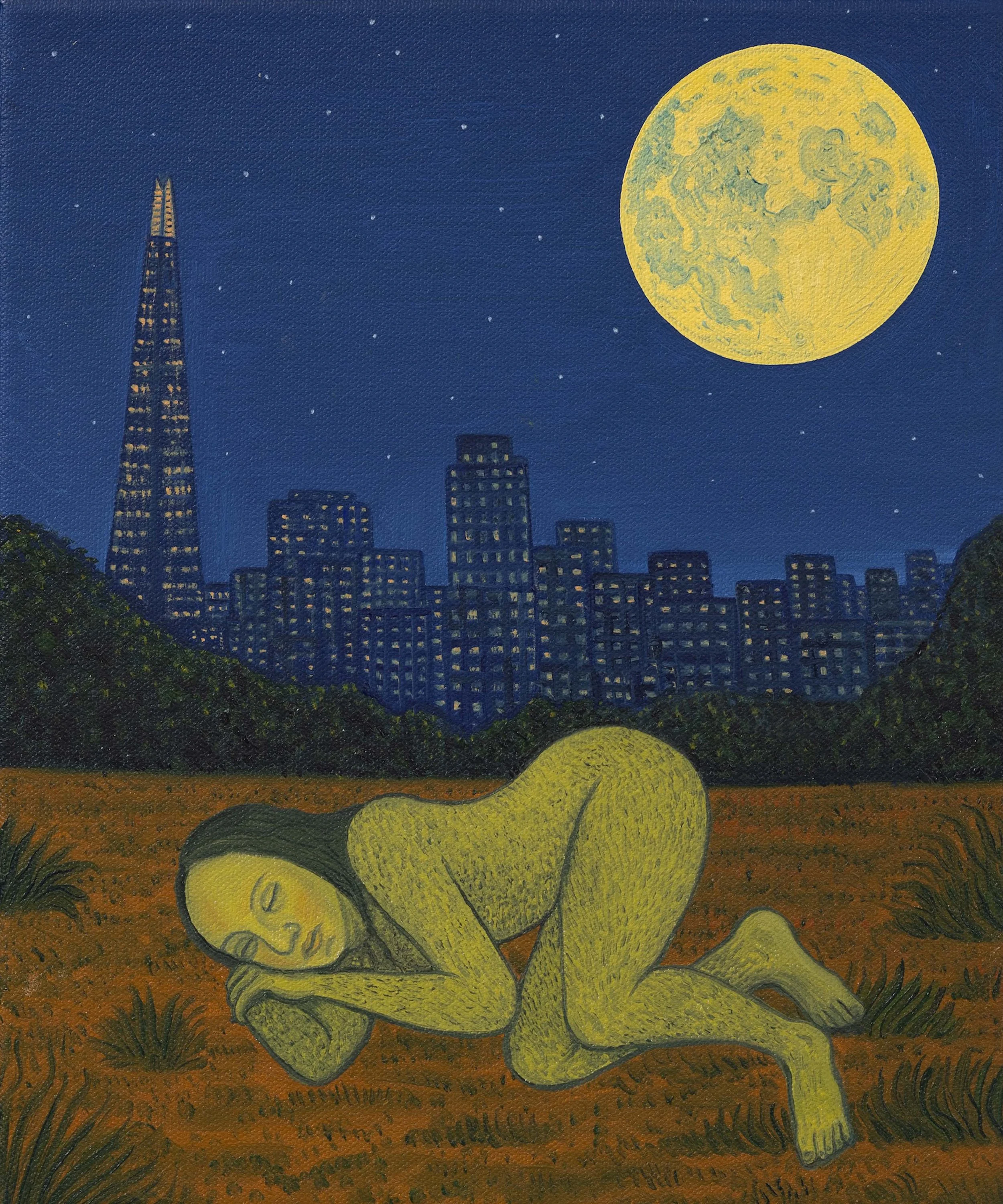
January’s full moon was once known to the Ancient Celts as the Quiet Moon, a name reflecting the barren landscape and stillness of midwinter. Yet even in the depths of winter, the days are beginning to lengthen as we move slowly from the winter solstice towards the spring equinox, when the land will once again begin to awaken.
This time of year has traditionally been one of reflection—a still, inward season and a hopeful time for planting new seeds of intention and resolve, which, in time, will take root and quietly flourish.
It felt an appropriate moon under which to paint Albina, the mythological founder of Britain and the central figure in my painting Children of Albion. According to medieval legend, Albina and her thirty-three sisters were forced into marriages by their tyrannical father. In an act of rebellion, they murdered their husbands and were exiled from their homeland of Syria, setting sail across the sea to an uninhabited island. There they became the first inhabitants of a land they named Albion after Albina, before coupling with the spirits of the land and giving rise to a race of giants in one of Britain's most enduring foundation myths. Later, William Blake reimagined Albion as the ancient spirit of Britain, a sleeping giant waiting to be awakened through the power of the poetic imagination.
Through the lens of Carl Jung's archetypes, Albina can also be understood as a manifestation of the Great Mother—an ancestral Mother Earth figure embodying creation, transformation and renewal. For me, she has become a symbol of Britain's deeply interconnected heritage. Her story begins with migration and encounter, reminding us that the identity of these islands has never been fixed, but has continually evolved through movement, exchange and the meeting of different peoples, cultures and ideas.
As she sleeps beneath the Quiet Moon, Albina becomes both guardian and embodiment of the land itself, reminding us that beneath winter's apparent stillness, life is quietly preparing for renewal.
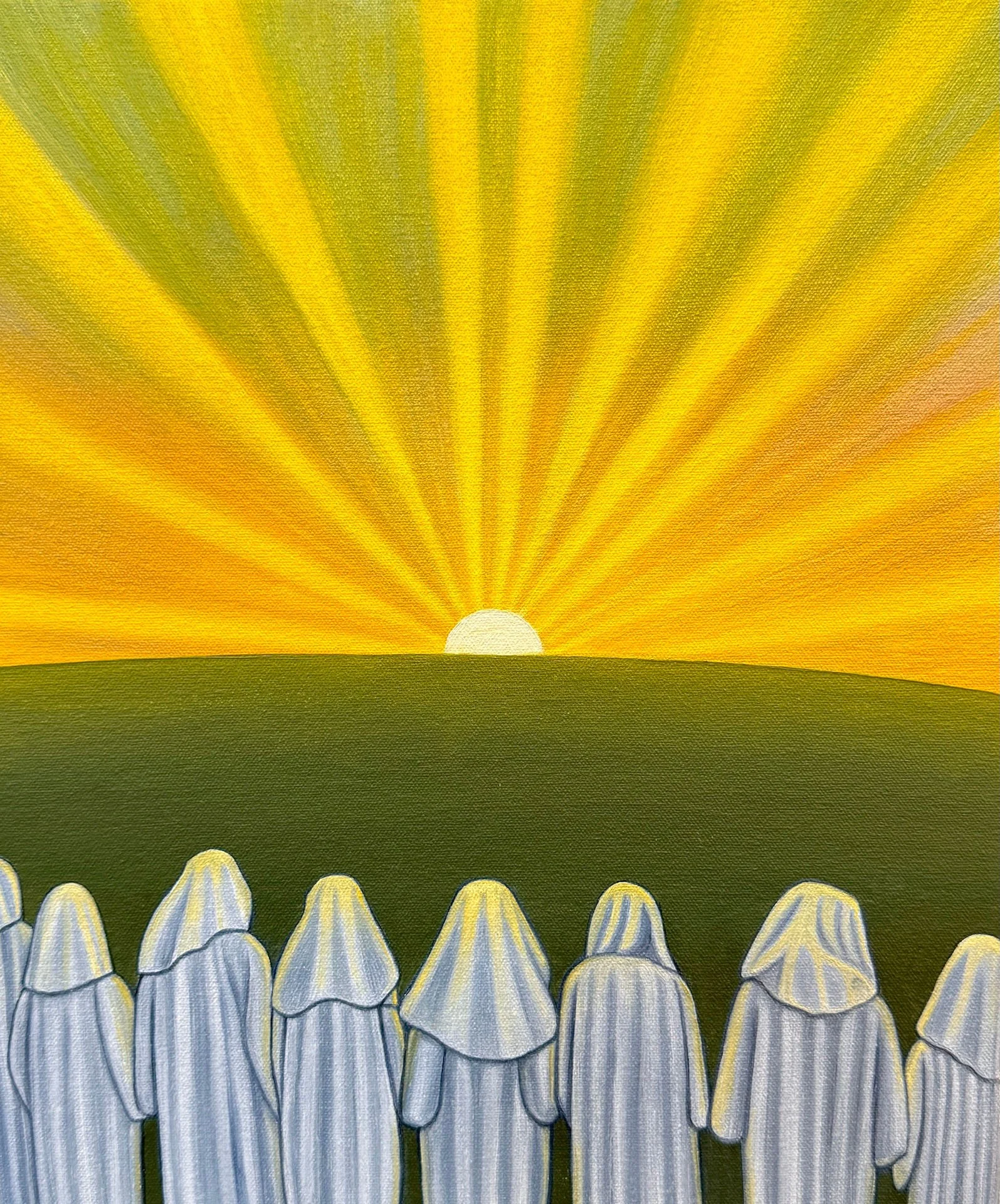
All Hail the Solstice Sun is inspired by the Summer Solstice, a celestial event that has been honoured by cultures across the world since time immemorial. Marking the longest day of the year, the solstice reminds us that human life is inseparable from the rhythms of the Earth and the wider cosmos.
Although rooted in folklore, my work is fundamentally concerned with our relationship to the natural world. For thousands of years, rituals celebrating the rising sun have reflected an understanding that humanity is not separate from nature, but part of an interconnected system linking the Earth, the cosmos and all living things.
Through this painting I wanted to celebrate that enduring connection between the terrestrial and the celestial. It is both a tribute to one of humanity's oldest shared rituals and a reminder that we remain participants in the same natural and cosmic cycles that continue to shape life on Earth.